What Is Whitelisting on Social Media? Influencer Whitelisting Explained
Whitelisting lets brands run paid ads from a creator’s Instagram or Facebook account. How it works, what it costs, our test results, and the Meta setup steps.

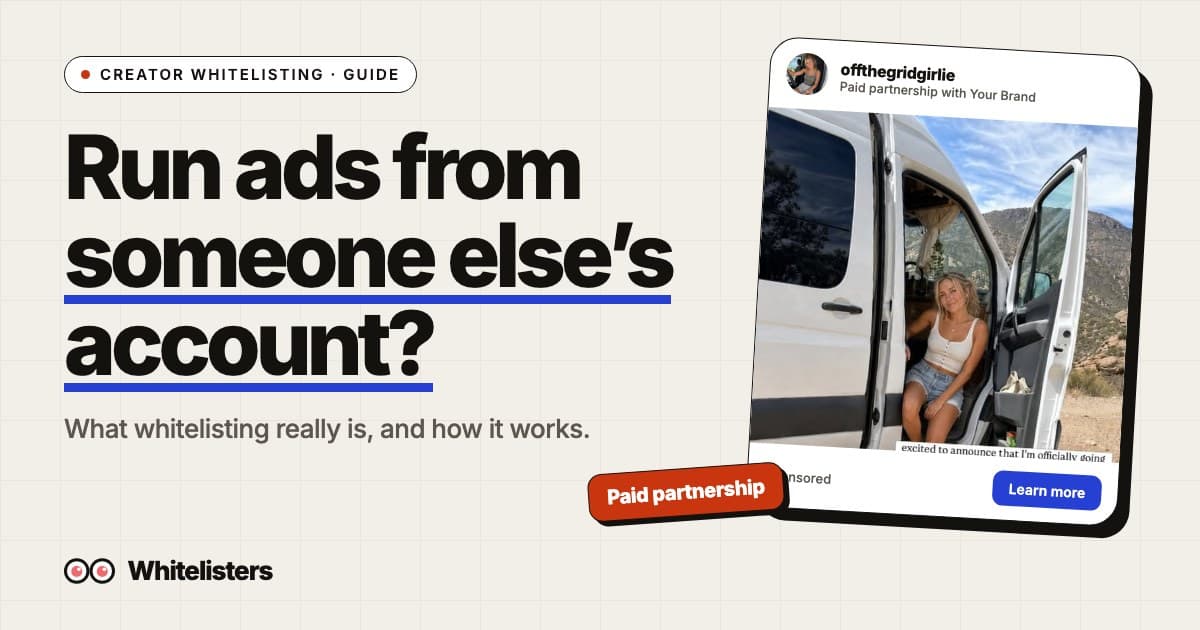
Whitelisting on social media is when a creator authorizes a brand to run paid ads through the creator’s account. The ad shows the creator’s name and profile photo as the advertiser, while the brand controls the creative, targeting, budget and reporting from its own ad account.
You’ll also hear it called influencer whitelisting, creator licensing or, on Meta, partnership ads. Meta’s own documentation says it plainly: “Branded content ads are now called partnership ads.” The idea is the same in every case: put your ad behind the trust people already give a creator.
How whitelisting works
A whitelisted ad has two parties. The creator owns the identity: the handle, name and profile photo the ad appears under. The brand owns everything else: the creative, the audience, the budget and the results. Meta describes the format the same way: the partner and advertiser accounts are featured in the ad’s header, and the ads use signals from both accounts for improved ranking and incremental performance.
- Permission. To run partnership ads, advertisers need permission from the partner whose handle the ad will include, and the partner can revoke it at any time.
- Identity. With permission in place, the creator’s account becomes available as an identity in the brand’s ad account.
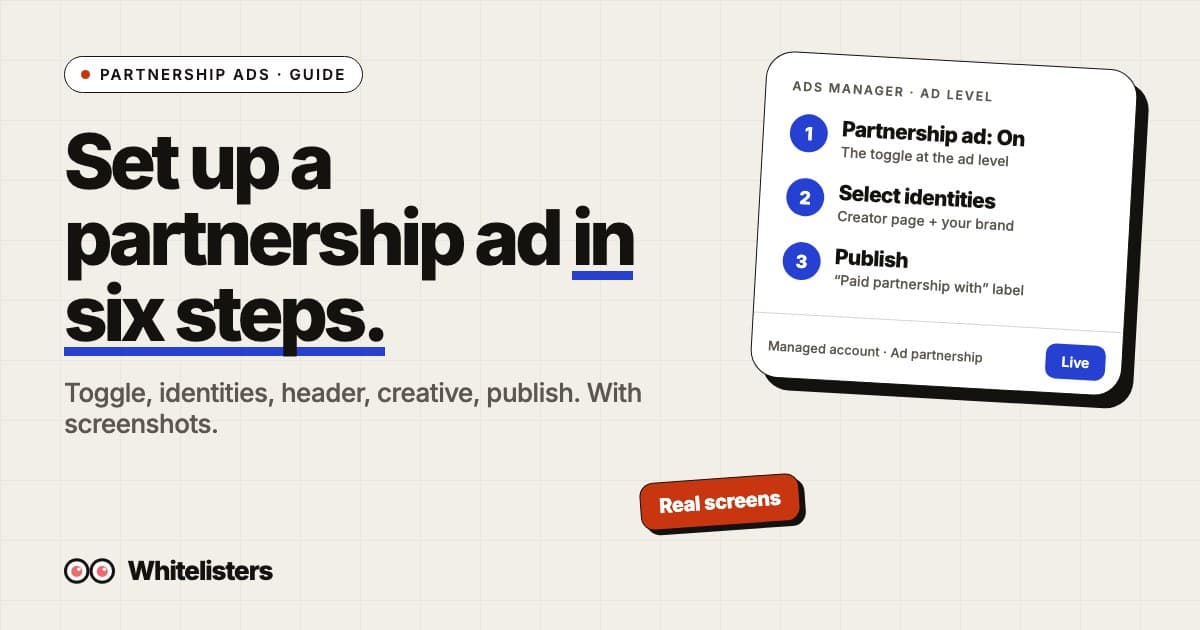
- Publishing. The brand builds the ad in Ads Manager, turns on the partnership ad toggle at the ad level and picks the creator’s identity. Meta reviews the ad before it runs.
The step-by-step version is in our complete guide to Meta partnership ads.
Whitelisting vs. partnership ads vs. Spark Ads
These terms overlap. Here’s how they compare.
| Whitelisting | Meta partnership ads | TikTok Spark Ads | |
|---|---|---|---|
| What it is | The general practice | Meta’s built-in format | TikTok’s version |
| Platforms | Any that allow it | Instagram, Facebook | TikTok |
| Who grants access | The creator | The creator, in Meta | The creator, in TikTok |
Why brands use whitelisted ads
People treat a post from a person differently from a post by a brand. An ad under a creator’s name looks like something from an account they might follow, not an interruption. Meta lists the same benefit for advertisers: partnering with creators to produce more authentic and engaging content that results in more performant ads.
Here is what we saw when we tested it ourselves.
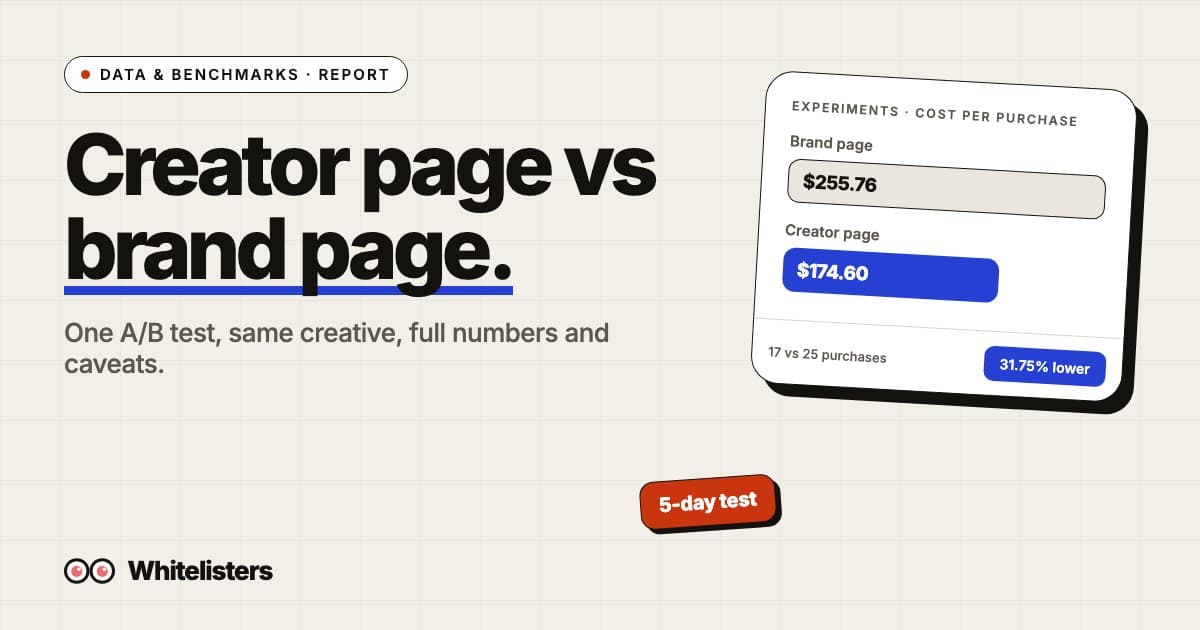
We ran this test in Meta Ads Manager’s Experiments tool in August 2026 (August 26 to 30). Both ad sets used the same creative, budget and audience. The only difference was the page identity: one ad set ran from the brand’s own page, the other from a Whitelisters creator page (@offthegridgirlie). The goal was website purchases, and each side spent about $4,350 (cost per purchase multiplied by purchases).
| Test group | Cost per purchase | Purchases | Reach | Impressions |
|---|---|---|---|---|
| A: Brand page | $255.76 | 17 | 291K | 506K |
| B: Whitelisters page | $174.60 | 25 | 259K | 521K |
Cost per purchase was 31.75% lower on the Whitelisters page. Treat this as one data point, not a promise. It is a single test with a small sample (17 and 25 purchases), and it ran for five days, shorter than the seven-day minimum Meta recommends for the most reliable A/B results. The way to know what your own ads will do is to run the same split on your account.
The full method and arithmetic are in partnership ads vs brand page ads. We see the same direction in client accounts. These comparisons are not controlled experiments, but they cover far more spend:
| Brand | Brand page | Whitelisters pages | Difference | Spend compared |
|---|---|---|---|---|
| Cloaked | $196.52 | $160.52 | 18% lower, $36 saved per purchase | $7.25M brand page vs $2.63M Whitelisters pages |
| Rise Science | $38.55 | $25.01 | 35% lower, and 26% lower cost per 1,000 impressions | $155K brand page vs $266K across 12 Whitelisters pages |
These compare ads that ran through each kind of page over real spend. They are not controlled experiments. For Cloaked, the comparison is Mindful-built ads on creator pages (230 ads) against the other ads on the brand page (3,301 ads), so the creative differs. For Rise Science it is the same Mindful-built ad concepts on 12 creator pages (619 ads) against the brand page (480 ads); the 24 concepts that ran on both cost $24.34 per purchase on creator pages and $38.02 on the brand page. Delivery cost also differed: Cloaked’s creator-page ads cost more per 1,000 impressions ($34.84 against $27.09) but converted better, while Rise Science’s creator-page ads were cheaper to show as well. The results point the same way as our A/B test, which is why we recommend testing it yourself.
Both brands are covered in detail in the Cloaked and Rise Science case study.
Why might it work? In Meta’s ad auction, the winning ad is the one with the highest total value, and that value combines the bid, the estimated action rate and ad quality. Meta notes that a more relevant ad can win against ads with higher bids. An ad that more people engage with can cost less to deliver. We cover this in more detail in how to lower CAC on Meta ads.
How to set up whitelisting in Meta Ads Manager
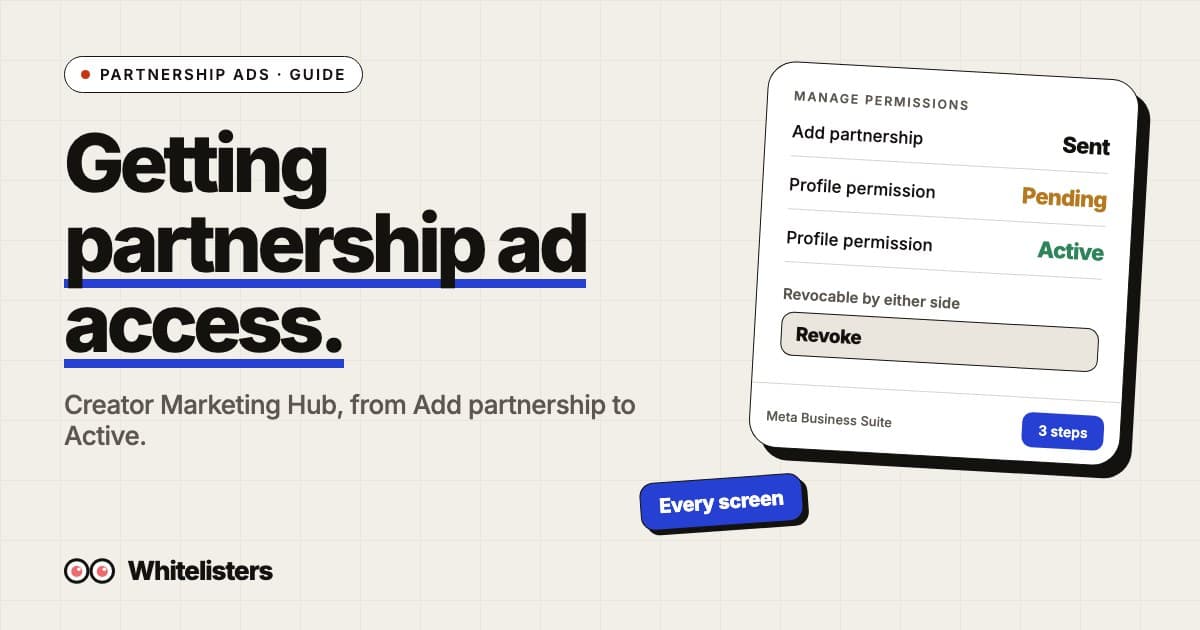
- Send an account-level request from Meta Business Suite: go to Creator Marketing, open Manage permissions, click Add partnership and search for the creator’s username. Meta documents each click.
- The creator accepts the request in Creator Marketing Hub, the Instagram app or the Facebook app.
- In Ads Manager, click Create, choose your objective, then at the ad level turn on the Partnership ad toggle and choose the identities to show. Meta’s setup guide covers both ad-code and no-code routes.
- Publish. Meta reviews the ad and notifies you when it is approved.
Screenshots of every screen are in how to request partnership ad access and how to set up partnership ads in Ads Manager.
How much does influencer whitelisting cost?
Whitelisting is usually priced separately from content. Many creators charge a recurring whitelisting or usage fee on top of whatever they’re paid to make the video, and the rate varies widely by creator. Brands working with many creators also pay in time: sourcing, negotiating, chasing approvals and renewing access when it lapses.
A roster model replaces the per-creator whitelisting fee. Whitelisters charges one flat price per brand Instagram account for access to every page on the roster: $999 a month, or $799 a month billed yearly. You still supply the creative. For what the ad spend itself costs, see how much Meta ads cost.
Disclosure and rules to know
- The label is built in. Meta’s paid partnership label reads “Paid partnership with” followed by the partner’s name, and a boosted post or unpublished ad also carries an “Ad” label.
- Branded content has its own policy. Meta’s Branded Content Policies prohibit some categories outright, restrict others such as financial products, and require written pre-authorization for categories like cryptocurrency and real-money gambling. You must also meet any legal disclosure rules that apply to you.
- Ad policies still apply. Partnership ads go through Meta’s ad review like any other ad.
- Permission can be withdrawn. The account owner can revoke it at any time, so confirm access before you launch and monitor it.
- Know who the creator is. Most pages on the Whitelisters roster are AI-generated influencer identities run by our team, and the rest are niche theme pages. Every ad runs with Meta’s paid partnership label. See AI influencers for paid social.
Frequently asked questions
Is whitelisting the same as a partnership ad?
On Instagram and Facebook, yes in practice. Partnership ads are Meta’s official format for running ads through a creator’s account, and Meta says branded content ads are now called partnership ads.
Can I use my own creative in a whitelisted ad?
Yes. With account-level permission you can create partnership ads from a partner’s handle without pre-existing content, including by uploading new creative in Ads Manager.
Can a creator take back access?
Yes. Meta says creators and other partners can revoke partnership ad permissions at any time.
How do I get access to Whitelisters pages?
Connect your Meta account in Whitelisters, pick the Instagram account you run ads from, then request any page you want. Whitelisters sends the partnership request through Meta for you. Once it is approved, select the page as your partner in Meta Ads Manager.
Is whitelisting allowed on Instagram and Facebook?
Yes. Meta supports it through partnership ads and requires the partner’s permission. Branded content must follow Meta’s Branded Content Policies, which prohibit some categories and restrict others.
What is the difference between whitelisting and boosting a post?
Boosting promotes a post from the same account. A whitelisted ad is a partnership ad that runs from a partner’s handle together with yours, with the partner’s permission. Meta says partnership ads use signals from both accounts.

Zachary DiBlasi
Zachary DiBlasi is the founder and CEO of Whitelisters and MindfulAds.com. He has managed over $200m in ad spend for brands including Kalshi, MrBeast, Descript, Framer, Justin Bieber and Runna by Strava.