How Much Do Meta Ads Cost? What Drives the Price (With a Worked Example)
Meta ads have no fixed price. How budgets, the auction and learning phase set your cost, plus a worked CPM and cost-per-result example from a real A/B test.

Meta ads have no fixed price. You set a budget, and the ad auction decides what each impression, click and result costs. Meta puts it this way: there are many factors that contribute to an ad campaign’s cost, and there isn’t a one-size-fits-all answer. What you can control is the budget, the objective, the audience and the quality of the ad. This guide explains how each one moves the price, with a worked example from our own test.
How budgets work
You choose one of two budget types, and Meta describes both on its pricing and cost page:
- Daily budget. The average you’re willing to spend per day on an ad set or campaign. Meta may spend up to 75% over the daily budget on a given day to capture opportunities, but it averages out over the week, so spend will not exceed seven times your daily budget.
- Lifetime budget. The total you’re willing to spend over the whole run. Daily spend fluctuates, but the total stays within your budget.
Meta recommends setting a budget you can sustain for at least seven days so the system can learn, and says its recommended starting point is a budget of at least $5 and a duration of more than six days. That is the minimum to get delivery started, not the amount that produces reliable results, which depends on your cost per result.
What drives the price
Meta lists these contributors: ad quality, bidding strategy, performance goal, budget type and objective. Underneath them is the auction. For each opportunity to show an ad, the winner is the ad with the highest total value, a combination of the bid, the estimated action rate and ad quality. Meta notes that a more relevant ad can beat ads with higher bids, which is why two advertisers with the same budget can pay very different prices.
| Driver | Effect on cost |
|---|---|
| Audience size | An audience that is too specific may cost more to reach. Meta says ad sets of at least 2 million often see better performance. |
| Placements | More placements give the auction more chances to find results. Meta calls Advantage+ placements typically the most efficient use of budget. |
| Learning phase | Ad sets usually have a higher CPA while learning, and exit after about 50 results in the week after the last significant edit. |
| Creative freshness | When an audience has seen the same creative too many times, cost per result can rise. Meta flags it when cost per result climbs above your past ads. |
| Budget changes | A budget that is very small or very inflated gives the system an inaccurate signal, and frequent changes can push an ad set back into learning. |
Sources for the table: Meta’s pricing overview, cost-per-result recommendations, the learning phase and creative fatigue recommendations.
The cost numbers to track
- CPM: cost per 1,000 impressions. It tells you what reach costs.
- CTR: the share of impressions that become clicks. It tells you how interesting the ad is.
- Cost per result: spend divided by results for your objective, such as purchases. This is the number that sets your CAC.
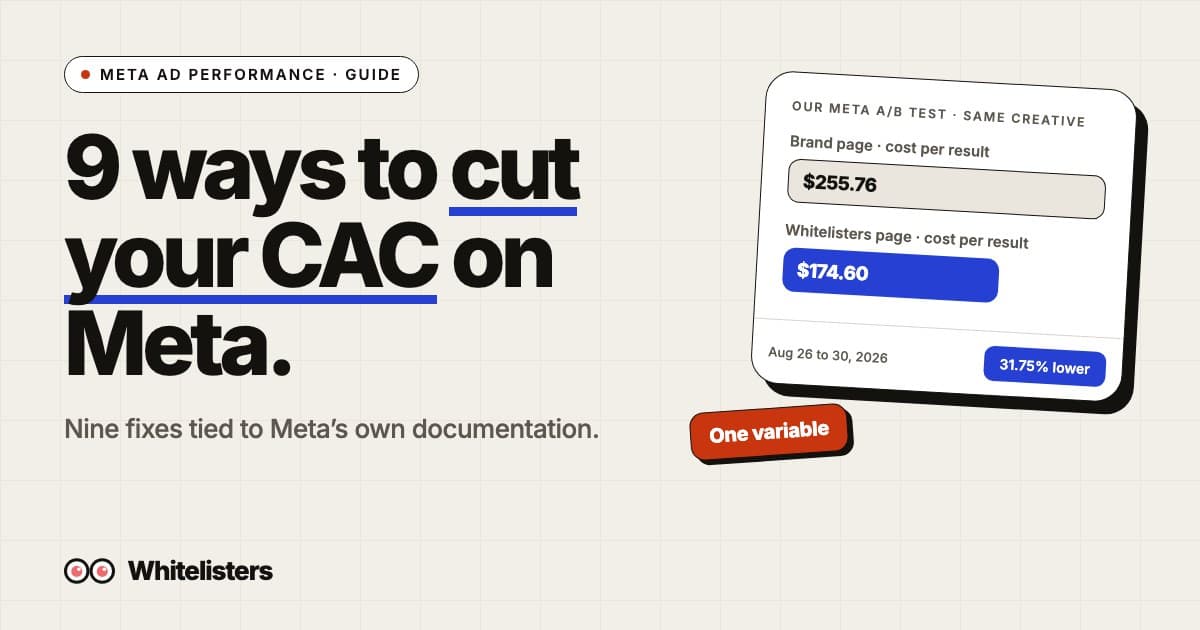
These connect: cost per result moves with both what an impression costs and how many impressions turn into results. Here is a worked example from our own Meta A/B test, where the same creative ran from a brand page and a Whitelisters page (August 26 to 30, 2026, Ads Manager Experiments):
| Brand page | Whitelisters page | |
|---|---|---|
| Cost per purchase (reported) | $255.76 | $174.60 |
| Purchases (reported) | 17 | 25 |
| Reach (reported) | 291K | 259K |
| Impressions (reported) | 506K | 521K |
| Spend (calculated) | about $4,350 | about $4,365 |
| CPM (calculated) | about $8.59 | about $8.38 |
Impressions cost almost the same on both sides, about $8.59 and $8.38 per 1,000. The 31.75% saving in cost per purchase came from more purchases on about the same number of impressions: 25 against 17. With only 17 and 25 purchases it is a small sample, and the test ran five days, shorter than the seven daysMeta recommends, so run your own before you plan around it.
How much budget does an ad set need?
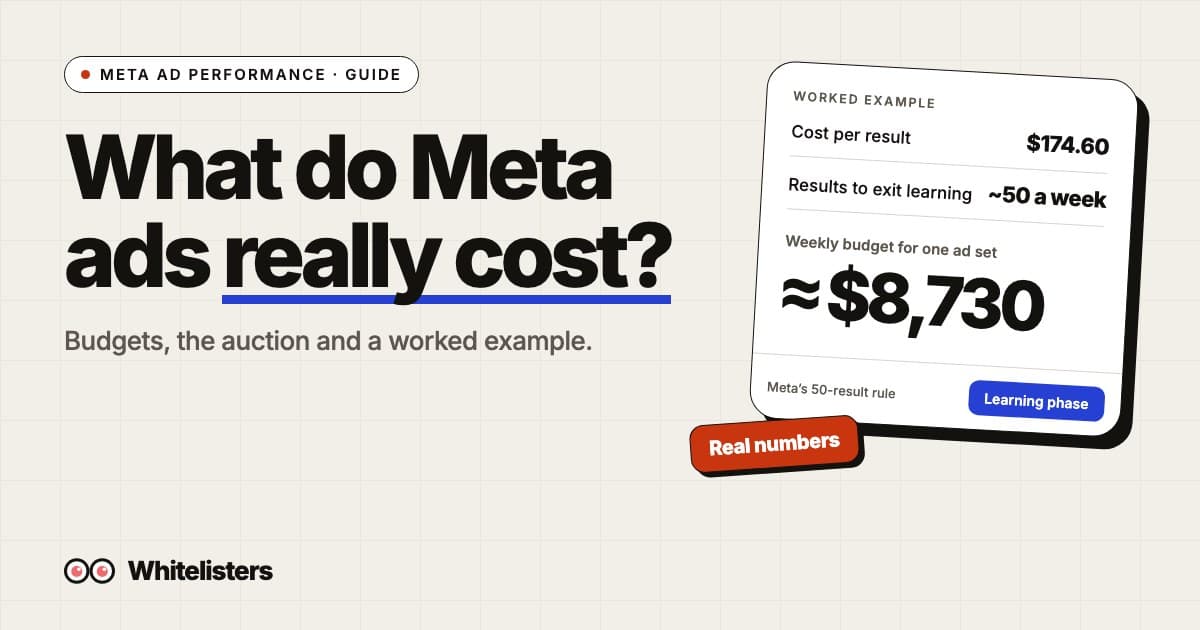
Use Meta’s learning-phase rule to size it. An ad set needs about 50 results in the week to exit learning, so the minimum weekly budget is roughly your cost per result multiplied by 50. At the $174.60 cost per result in the table, that is about $8,730 a week for one ad set to learn efficiently. At $255.76 it is about $12,800. Lower cost per result lowers the budget you need to get stable delivery, which is why cost per result is the number to work on first.
How the page an ad runs from changes the cost
We have seen cost move in two ways. In the A/B test above, the page identity changed how many impressions became results. In client data, one brand also saw cheaper delivery:
| Brand | Brand page | Whitelisters pages | Difference | Spend compared |
|---|---|---|---|---|
| Cloaked | $196.52 | $160.52 | 18% lower, $36 saved per purchase | $7.25M brand page vs $2.63M Whitelisters pages |
| Rise Science | $38.55 | $25.01 | 35% lower, and 26% lower cost per 1,000 impressions | $155K brand page vs $266K across 12 Whitelisters pages |
These compare ads that ran through each kind of page over real spend. They are not controlled experiments. For Cloaked, the comparison is Mindful-built ads on creator pages (230 ads) against the other ads on the brand page (3,301 ads), so the creative differs. For Rise Science it is the same Mindful-built ad concepts on 12 creator pages (619 ads) against the brand page (480 ads); the 24 concepts that ran on both cost $24.34 per purchase on creator pages and $38.02 on the brand page. Delivery cost also differed: Cloaked’s creator-page ads cost more per 1,000 impressions ($34.84 against $27.09) but converted better, while Rise Science’s creator-page ads were cheaper to show as well. The results point the same way as our A/B test, which is why we recommend testing it yourself.
For the full list of levers, see how to lower CAC on Meta ads, and for the format itself see our guide to partnership ads.
What whitelisting adds to the cost
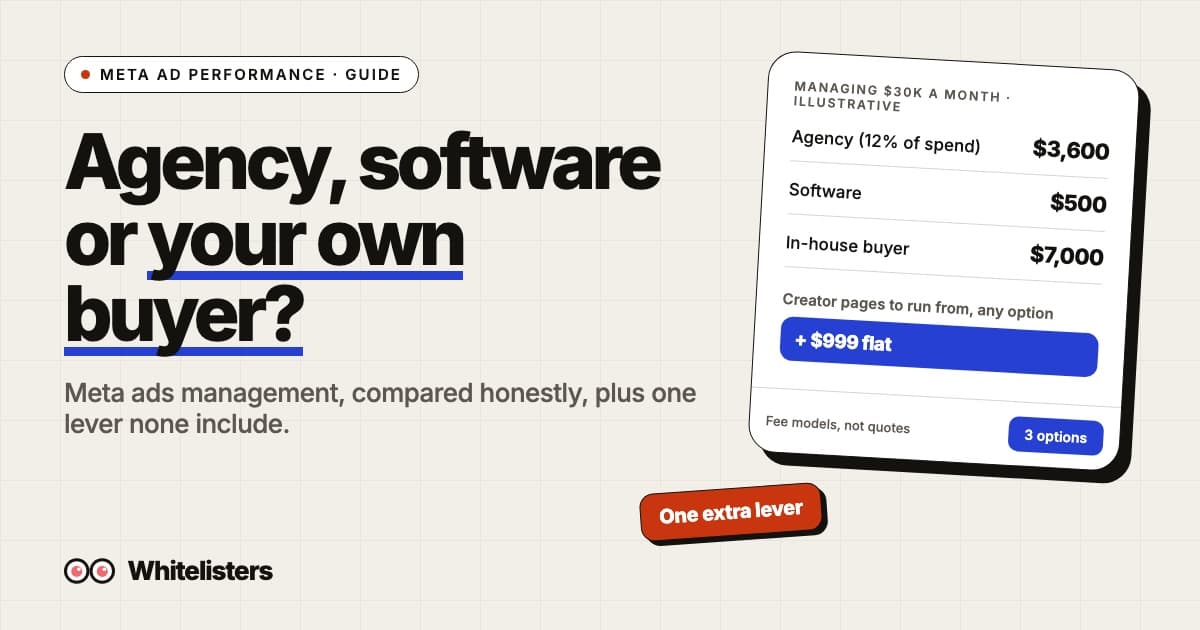
Ad spend is paid to Meta. Whitelisting is a separate line. With individual creators, whitelisting access is usually priced per creator on top of content fees. Whitelisters charges one flat price per brand Instagram account for the whole roster: $999 a month, or $799 a month billed yearly ($9,588), with no per-creator fees. Your ad spend is unchanged and paid to Meta as usual.
Frequently asked questions
What is the minimum budget for Meta ads?
Meta’s guidance suggests starting with a budget of at least $5 and a duration of more than six days. That gets delivery started, but the budget that gives stable results depends on your cost per result and the roughly 50 results an ad set needs each week to exit the learning phase.
What is the difference between a daily and a lifetime budget?
A daily budget is the average you will spend per day, and Meta may spend up to 75% over it on a given day while averaging out across the week. A lifetime budget is the total over the whole run, with daily spend that can fluctuate.
Why do two advertisers pay different prices for the same audience?
Because the winning ad in each auction has the highest total value, which combines the bid, the estimated action rate and ad quality. A more relevant ad can win against ads with higher bids.
Does whitelisting change what I pay Meta?
It changes results per impression, not Meta’s billing. In our A/B test, reach cost about the same on both sides and the saving came from more results per impression. Whitelisting itself is a separate cost, which is one flat price per brand Instagram account on Whitelisters.
How long should I run a budget before judging results?
Meta recommends a budget you can sustain for at least seven days so its system can learn, and ad sets usually need about 50 results in a week to exit the learning phase.
What is CPM?
CPM is the cost per 1,000 impressions. It tells you what reach costs, while cost per result tells you what an outcome such as a purchase costs.

Zachary DiBlasi
Zachary DiBlasi is the founder and CEO of Whitelisters and MindfulAds.com. He has managed over $200m in ad spend for brands including Kalshi, MrBeast, Descript, Framer, Justin Bieber and Runna by Strava.