Meta Ads Management: Agency, Software or Your Own Media Buyer?
Meta ads management compared: agency, software or in-house, the four fee models, a $30k worked example, and the creator-page lever none of them include.

Meta ads management is the work of planning, building, optimizing and reporting on Facebook and Instagram ads, and there are three ways to get it done: hire an agency, buy software, or run it with your own media buyer. Most pages on this topic are written by agencies and end with a sales form. This one is written by a team that runs partnership ads across 100+ creator pages every day, and it tries to answer the question honestly, including when an agency is the right call. The one thing none of the three options gives you by default is more pages to run your ads from, which is where Whitelisters fits, and we say exactly where that line is.
What is Meta ads management?
Meta ads management covers everything between “we have a budget” and “here is what it returned”: account and pixel setup, campaign structure, audiences, creative briefs and rotation, bidding and budgets, daily optimization, policy and compliance, and reporting. On Meta the manager also decides the identity each ad runs from, which is the Facebook Page or Instagram account shown in the ad header. That choice is often left on the default, your own brand page, and it is the lever this article keeps coming back to.
The job is the same whoever does it. What changes between an agency, software and an in-house buyer is who makes the decisions, how fast they are made, what it costs, and what you learn along the way.
Facebook ad management agency vs software vs in-house
| Agency | Software | In-house media buyer | |
|---|---|---|---|
| Who decides | The agency team, inside the scope you agreed | You, with the tool’s automation and recommendations | Your buyer, every day |
| How you pay | A percentage of spend, a flat retainer, a performance fee, or a mix | A subscription, often tiered by spend or seats | Salary or contractor rate, plus tools |
| Speed of change | Depends on the agency’s cadence and your approvals | As fast as you log in | Same day |
| Creative | Sometimes included, often a separate fee | Rarely included | Your team or freelancers |
| What you learn | What the reports tell you | Everything, if you read it | Everything |
| Identities you can run from | Your pages, plus any creator the agency sources for you | Your pages | Your pages, plus any creator you get permission from |
| Best when | You have budget but no time or team, or you need specialist help fast | You have a buyer and want less manual work | Spend is large enough to justify a full-time person |
The honest version of the choice: an agency buys you time and experience, software buys you leverage for a buyer you already have, and an in-house buyer buys you control and institutional knowledge. None of them is wrong. The mistake is picking one for a problem it does not solve, which is usually a creative or identity problem dressed up as a management problem.
Facebook ad management services: what they include and what they usually do not
A typical managed service covers:
- Account audit and setup: Business Manager, pixel and Conversions API, catalog, naming conventions.
- Strategy and structure: objectives, campaign and ad set architecture, audiences, budgets and bids.
- Creative direction: briefs, testing plans and rotation, sometimes production.
- Optimization: daily or weekly checks, scaling and pausing decisions, learning-phase management.
- Reporting: a dashboard or a monthly deck, with the metrics you agreed on.
- Policy: keeping ads inside Meta’s advertising and branded content rules.
What it usually does not include, and what to ask about:
- Additional identities. Most services run every ad from your brand page. Running the same ad from a creator’s page is a partnership ad, which Meta says uses signals from both accounts for improved ranking and incremental performance. It needs the creator’s permission, so it is sourcing work, not media buying, and it is rarely in scope.
- Clean tests. Ask whether the service runs its tests in Meta’s Experiments tool. Meta warns that informal testing can lead to overlapping audiences and unreliable results.
- Ownership of the data. The ad account, pixel and audiences should sit in your Business Manager, with the provider added as a partner, so nothing leaves when they do.
What does Facebook ad management cost?
There is no single number, and anyone who gives you one without seeing your account is guessing. What you can pin down is the fee model, and there are four:
- Percentage of ad spend. The fee rises with the budget. Simple, but the provider earns more when you spend more, whatever the result.
- Flat retainer. A fixed monthly fee for a defined scope. Predictable, and it rewards efficiency, but scope creep is the usual argument.
- Performance fee. A share of revenue or a bonus above a target. Aligned on paper, hard to attribute cleanly on Meta.
- Hybrid. A smaller retainer plus a percentage or a performance component.
Whitelisters is not a management service, so its price is a different line on the same budget. It is one flat plan per brand Instagram account: $999 a month, or $799 a month billed yearly, with unlimited partnership ads across every page on the roster and no per-creator fees. The first 14 days are free.
A worked example at $30,000 a month
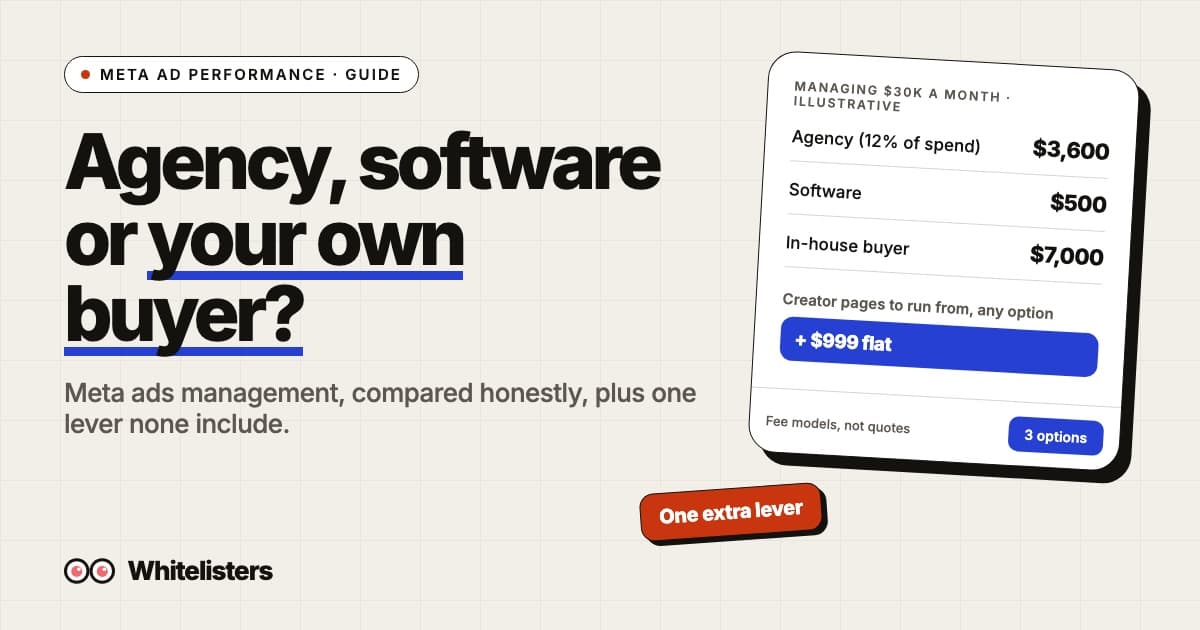
The arithmetic below uses illustrative fee assumptions so you can see the shape of each option. Replace them with your own quotes.
| Line | Agency (assume 12% of spend) | Software (assume $500 a month) | In-house buyer (assume $7,000 a month loaded) |
|---|---|---|---|
| Media | $30,000 | $30,000 | $30,000 |
| Management | $3,600 | $500 | $7,000 |
| Creative | Quoted separately | Your cost | Your cost |
| Creator pages to run from (Whitelisters, one brand account, monthly) | $999 | $999 | $999 |
| Total, before creative | $34,599 | $31,499 | $37,999 |
| Management as a share of media | 12% | about 1.7% | about 23% |
Two things the table makes visible. First, the in-house buyer looks expensive at $30,000 a month and cheap at $300,000, because the fee does not scale with spend. Second, the creator-page line is small next to the media line, which is why it is worth testing as a lever before you change who manages the account.
Managing ads across 100+ creator pages with your own media buyer
Here is how the identity lever works inside normal Meta ads management, whoever is doing the managing. The steps are Meta’s, with the permission step handled by Whitelisters.
- Connect. Connect your Meta account in Whitelisters and pick the Instagram account you run ads from.
- Request pages. Browse the roster and request the pages you want. Whitelisters sends the partnership request through Meta for you; the permission is the same account-level permission Meta describes in its partnership ad permissions page, and it shows up in your Creator Marketing Hub like any other partner. The screens are in how to request partnership ad access.
- Build the ad as usual. In Ads Manager, turn on the Partnership ad toggle at the ad level and choose the creator page as the identity. Same creative, same audience, same budget rules. The step-by-step screenshots are in how to set up partnership ads in Ads Manager.
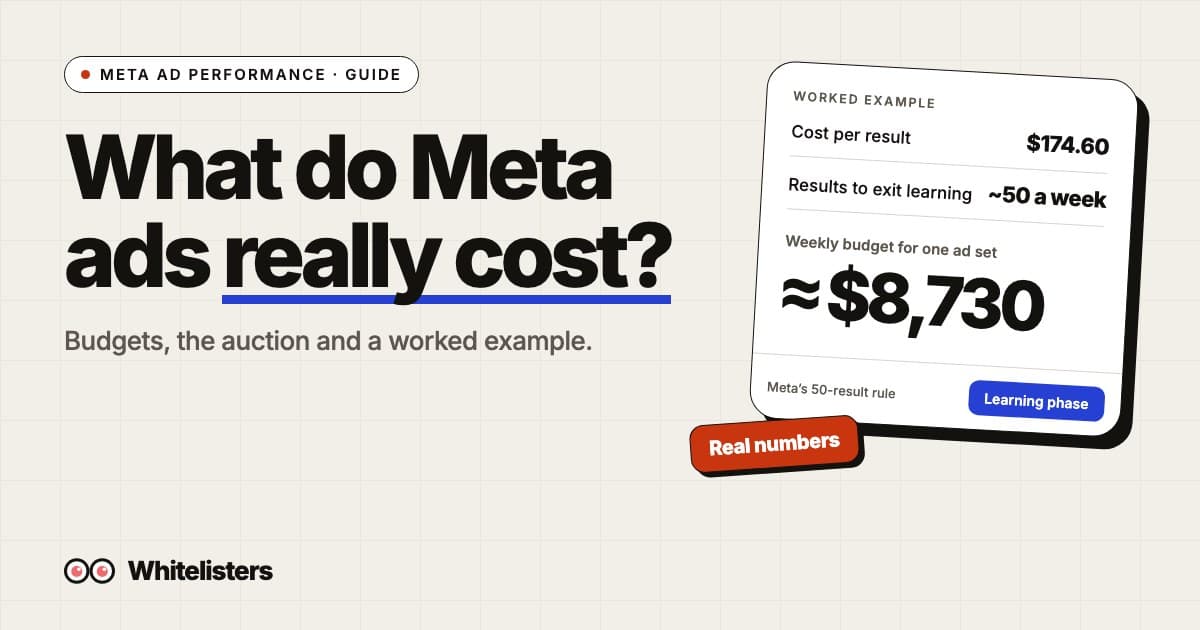
- Test it properly. Run the brand page against the creator page in Experiments with one variable changed, for at least seven days, with enough budget to exit the learning phase (about 50 results in a seven-day period).
- Scale what wins. Add pages for winning creatives, rotate identities when frequency climbs, and keep the reporting in your own Ads Manager because that is where it already is.
Nothing here replaces the manager. It gives the manager, agency or in-house, a second lever next to creative and audience, and it costs one flat line to try.
White label Facebook ads management with creator pages
Agencies can run the same workflow for clients. Each client connects their own Business Manager and Instagram account, so the permissions sit with the client and the agency works inside them, which is also how Meta expects agencies to operate: the advertiser grants the agency permissions across the Instagram account, Facebook Page and ad account. Billing is per brand Instagram account, so an agency with five clients has five lines, each cancellable on its own. The full multi-client setup, with the questions agencies ask about one Business Manager versus several, is coming as its own guide.
What the results looked like
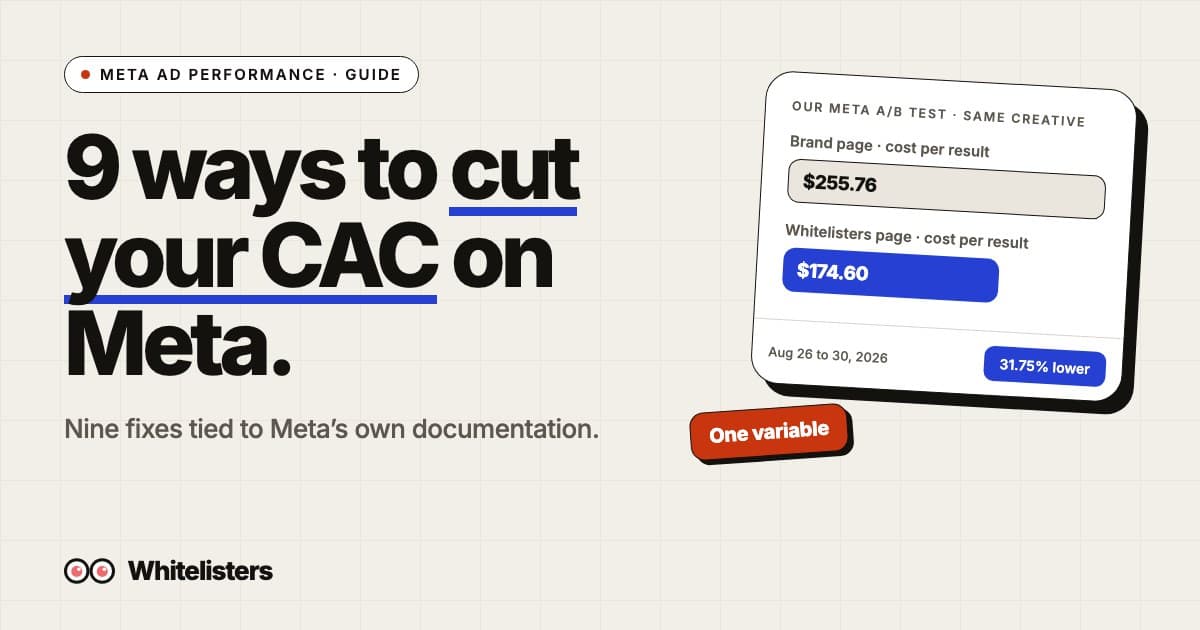
The reason to care about the identity lever is the result, so here is the evidence we publish, with its limits. In an A/B test in Meta’s Experiments tool with the same creative on both sides, the creator page cost $174.60 per purchase and the brand page $255.76, over about $4,350 of spend each. It was one test over five days with 17 and 25 purchases, so it is a data point. The full numbers and caveats are in partnership ads vs brand page ads. Two client accounts show the same direction over far more spend, as observational comparisons rather than controlled tests:
| Brand | Brand page | Whitelisters pages | Difference | Spend compared |
|---|---|---|---|---|
| Cloaked | $196.52 | $160.52 | 18% lower, $36 saved per purchase | $7.25M brand page vs $2.63M Whitelisters pages |
| Rise Science | $38.55 | $25.01 | 35% lower, and 26% lower cost per 1,000 impressions | $155K brand page vs $266K across 12 Whitelisters pages |
These compare ads that ran through each kind of page over real spend. They are not controlled experiments. For Cloaked, the comparison is Mindful-built ads on creator pages (230 ads) against the other ads on the brand page (3,301 ads), so the creative differs. For Rise Science it is the same Mindful-built ad concepts on 12 creator pages (619 ads) against the brand page (480 ads); the 24 concepts that ran on both cost $24.34 per purchase on creator pages and $38.02 on the brand page. Delivery cost also differed: Cloaked’s creator-page ads cost more per 1,000 impressions ($34.84 against $27.09) but converted better, while Rise Science’s creator-page ads were cheaper to show as well. The results point the same way as our A/B test, which is why we recommend testing it yourself.
Method, exclusions and per-brand tables are in the Cloaked and Rise Science case study.
Questions to ask any ad management provider
- Which fee model do you use, and what happens to the fee when results fall?
- Will the ad account, pixel and audiences live in my Business Manager?
- How do you test: Experiments, or turning ad sets on and off?
- What is your creative cadence, and is production included?
- Which identities will my ads run from, and can you run partnership ads from creator pages?
- What do I see in reporting, and how often?
- What is the notice period, and what do I keep when we part?
If a provider answers the identity question with “we only run from your page”, that is not a reason to walk away. It is a reason to add the lever yourself, because it costs one flat line and lowering CAC on Meta is mostly a matter of having more levers than the competition in the same auction.
Frequently asked questions
What is Meta ads management?
The planning, setup, creative, optimization, compliance and reporting work behind Facebook and Instagram ads. It can be done by an agency, by software that supports your own buyer, or by an in-house media buyer. On Meta it also includes choosing the identity each ad runs from.
Should I hire a Meta ads management agency or use a tool?
Hire an agency when you have budget but no time or team, or need specialist help fast. Use software when you already have a buyer and want less manual work. Bring it in-house when spend is large enough to justify a full-time person. Pick for the problem you have; most underperformance is a creative or identity problem, not a management one.
What does Facebook ad management cost?
It depends on the fee model: a percentage of ad spend, a flat retainer, a performance fee or a hybrid. There is no reliable single number without seeing the account. Whitelisters is a separate line: one flat plan per brand Instagram account with unlimited partnership ads and no per-creator fees, listed on the pricing page.
Can I use Whitelisters with my own media buyer or agency?
Yes. Whitelisters only handles the partnership permission for the creator pages. Your buyer or agency builds and runs the ads in your own Ads Manager, chooses the creator page as the identity, and reports from the same account as always.
Does running ads from a creator page change how the account is managed?
Very little. You turn on the Partnership ad toggle at the ad level and choose the page as the identity. Audiences, budgets, learning phase and reporting work the same way. Meta notes that partnership ads use signals from both the partner and advertiser accounts.
How should I test an agency or a creator page before committing budget?
Use Meta’s Experiments tool with one variable changed, run it for at least seven days, and give each side enough budget to exit the learning phase, which Meta says usually takes about 50 results in a seven-day period.
Can an agency white-label this for clients?
Yes. Each client connects their own Business Manager and Instagram account, so permissions stay with the client and the agency works inside them. Billing is per brand Instagram account, so each client is its own line.

Zachary DiBlasi
Zachary DiBlasi is the founder and CEO of Whitelisters and MindfulAds.com. He has managed over $200m in ad spend for brands including Kalshi, MrBeast, Descript, Framer, Justin Bieber and Runna by Strava.