Partnership Ads vs. Brand Page Ads: What Our A/B Test Shows
Same creative, two identities: in our Meta A/B test the creator page cost $174.60 per purchase vs $255.76 from the brand page. Numbers, method, caveats.

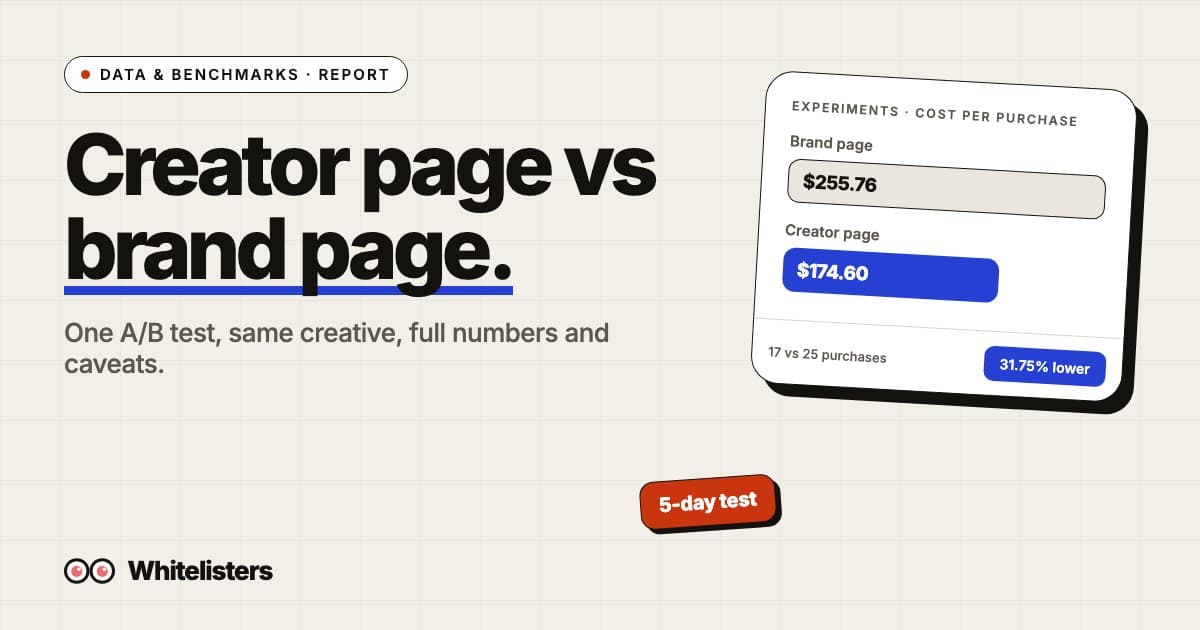
In an A/B test run in Meta Ads Manager’s Experiments tool in August 2026, the same creative cost $174.60 per website purchase from a Whitelisters creator page and $255.76 from the brand’s own page, 31.75% less. It is one five-day test with 42 purchases in total, so treat it as a data point, not a rule, and run the same split on your own account.
This report publishes the full numbers, the method, the arithmetic behind the percentages and the limits of the test. The screenshot is from the Experiments tab of the account that ran it.
What did we test?
One variable: the page identity the ad runs from. Two ad sets were created inside a Meta A/B test with the same creative, budget, audience and website-purchase objective. The first ran from the brand’s own Facebook Page and Instagram account. The second ran as a partnership ad from the Whitelisters creator page @offthegridgirlie. Meta reported the result as cost per result for website purchases. The test ran from August 26 to 30, 2026.
![Meta Ads Manager Experiments performance comparison. Metric: cost per result, website purchases. Ad set Mindful Testing [Aug2026 - 10]: $255.76, 17 results, 291K reach, 506K impressions. Ad set Mindful Testing [Aug2026 - 10 [partner]: $174.60, 25 results, 259K reach, 521K impressions.](/_next/image?url=%2Fblog%2Fpartnership-ads-vs-brand-page-ads%2F01-experiments-report.jpg&w=3840&q=75&dpl=dpl_EcTY4qbfsdaqvnVjz3S3SXGmnCBd)
What were the results?
| Metric | A: Brand page | B: Creator page | Difference |
|---|---|---|---|
| Cost per website purchase | $255.76 | $174.60 | 31.75% lower |
| Purchases | 17 | 25 | +8 |
| Reach | 291K | 259K | 11% fewer people |
| Impressions | 506K | 521K | 3% more |
| Implied spend (purchases × cost) | about $4,348 | about $4,365 | Equal within 1% |
| Implied CPM (spend ÷ impressions × 1,000) | about $8.59 | about $8.38 | 2% lower |
| Implied frequency (impressions ÷ reach) | about 1.74 | about 2.01 | Higher on the creator page |
The worked arithmetic: 17 purchases × $255.76 = $4,347.92 and 25 × $174.60 = $4,365.00, so both sides spent the same money within about $17. The gap is therefore in purchases per dollar, not in budget. Delivery cost barely moved (about $8.59 against $8.38 per thousand impressions), so the creator page did not win by buying cheaper impressions. It reached fewer people, showed the ad to them more often, and converted more of them.
Why might a creator page cost less per purchase?
Three documented mechanisms, none of them specific to Whitelisters. First, Meta says partnership ads use signals from both accounts for improved ranking and incremental performance. Second, in Meta’s auction the winning ad has the highest total value, which combines the bid, the estimated action rate and ad quality, so a more relevant ad can win against ads with higher bids. Third, people read a post from a person differently from a post from a brand: the same video under a creator’s handle is not framed as an interruption.
What does this test not prove?
- It is one test. One brand, one product, one creative, one creator page, one audience.
- The sample is small. 17 and 25 purchases. A handful of purchases either way would move the percentage a lot.
- It ran five days. Meta recommends at least seven days for the most reliable A/B results.
- Purchases are Meta-reported. Website purchases with the account’s default attribution setting, not a lift study or back-end revenue.
- No click-through rate. The Experiments report we exported did not include it, so we do not quote one.
- A second experiment is excluded. We ran another A/B test in the same month; delivery between its two sides was unequal, so it is not a clean comparison and we leave it out.
What do we see across client spend?
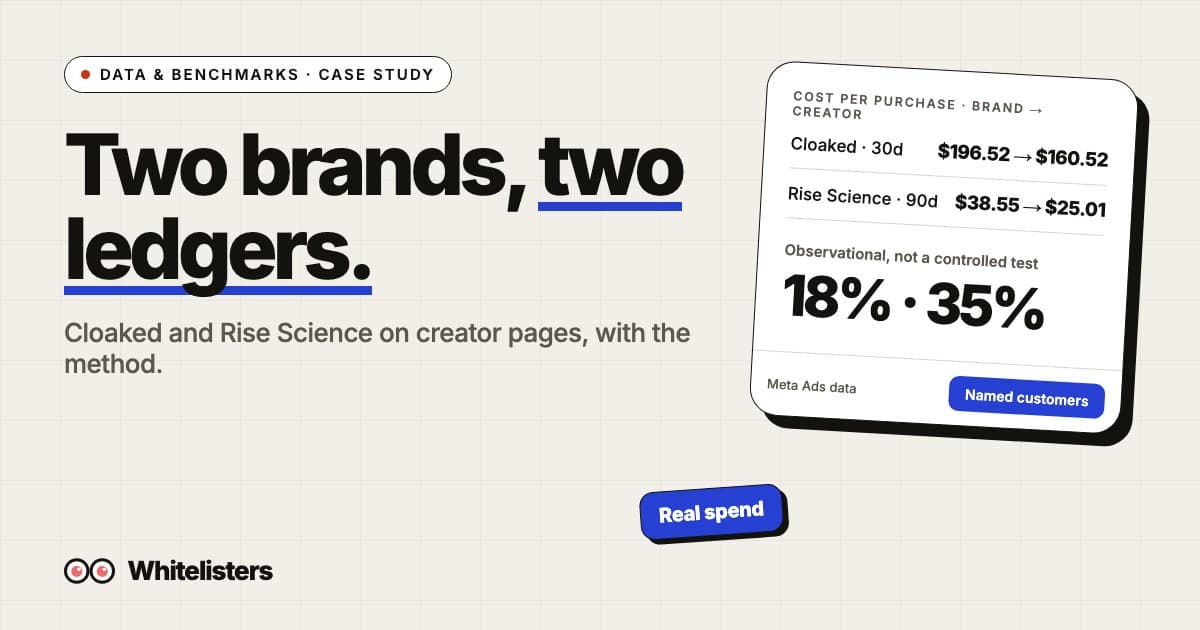
The test is small. Client accounts are not. Two brands that run ads from both their own page and Whitelisters pages show the same direction over far more spend, with the caveat that these are observational comparisons, not controlled tests:
| Brand | Brand page | Whitelisters pages | Difference | Spend compared |
|---|---|---|---|---|
| Cloaked | $196.52 | $160.52 | 18% lower, $36 saved per purchase | $7.25M brand page vs $2.63M Whitelisters pages |
| Rise Science | $38.55 | $25.01 | 35% lower, and 26% lower cost per 1,000 impressions | $155K brand page vs $266K across 12 Whitelisters pages |
These compare ads that ran through each kind of page over real spend. They are not controlled experiments. For Cloaked, the comparison is Mindful-built ads on creator pages (230 ads) against the other ads on the brand page (3,301 ads), so the creative differs. For Rise Science it is the same Mindful-built ad concepts on 12 creator pages (619 ads) against the brand page (480 ads); the 24 concepts that ran on both cost $24.34 per purchase on creator pages and $38.02 on the brand page. Delivery cost also differed: Cloaked’s creator-page ads cost more per 1,000 impressions ($34.84 against $27.09) but converted better, while Rise Science’s creator-page ads were cheaper to show as well. The results point the same way as our A/B test, which is why we recommend testing it yourself.
The full method, exclusions and per-brand tables are in the Cloaked and Rise Science case study.
How do you run this test on your own account?
- Get partnership ad permission on the creator page first. How to request it, or connect Whitelisters and request a roster page.
- In Ads Manager, open Experiments and create an A/B test. Meta warns that informal testing can lead to overlapping audiences and unreliable results, so use the tool rather than two campaigns side by side.
- Build two ad sets that differ in one thing only: the identity. Same creative, copy, link, audience, placements, budget and optimization event. Setting the identity is at the ad level.
- Pick cost per result for your conversion as the key metric and let it run at least seven days. Budget so each side can finish the learning phase, which Meta says needs about 50 optimization events in a seven-day period.
- Read the result as one data point, then repeat with a second creative or a second creator page before you move budget.
Frequently asked questions
What was the difference in cost per purchase between the creator page and the brand page?
$174.60 from the creator page against $255.76 from the brand page, which is 31.75% lower, in a Meta Experiments A/B test with identical creative run August 26 to 30, 2026.
Was the budget the same on both sides?
Yes, within about 1%. Purchases multiplied by cost per purchase gives about $4,348 for the brand page and about $4,365 for the creator page.
Did the creator page get cheaper impressions?
Barely. Implied CPM was about $8.59 for the brand page and $8.38 for the creator page. The difference came from more purchases per impression, not cheaper delivery.
Why is a five-day test a limitation?
Meta recommends running A/B tests for at least seven days for the most reliable results. Ours ran five, with 17 and 25 purchases, so the percentage carries real uncertainty.
Is 31.75% what every brand should expect?
No. It is one test on one account. Two client accounts show 18% and 35% lower cost per purchase on creator pages, but as observational comparisons rather than controlled tests. Run the split on your own account.
How do I run the same test?
Use Meta’s Experiments tool, create two ad sets that differ only in the identity the ad runs from, choose cost per result for your conversion as the key metric, and run it for at least seven days with enough budget to exit the learning phase.

Zachary DiBlasi
Zachary DiBlasi is the founder and CEO of Whitelisters and MindfulAds.com. He has managed over $200m in ad spend for brands including Kalshi, MrBeast, Descript, Framer, Justin Bieber and Runna by Strava.