How to Lower CAC on Meta Ads: 9 Fixes Backed by Meta’s Own Guidance
Nine ways to lower cost per customer on Meta ads, from the auction and learning phase to creative fatigue and page identity, with our A/B test results.

To lower customer acquisition cost (CAC) on Meta ads, make your ads more relevant to the people who see them, give the delivery system enough room to learn, and change one thing at a time. Meta’s own guidance points to a short list of levers: the auction’s relevance signals, the learning phase, audience and placement breadth, budget structure and creative freshness. One lever most brands never test is the identity the ad runs from, which is where creator pages come in.
CAC here means cost per customer, which on Meta usually means cost per purchase or cost per result for your objective. Meta’s documentation says results “may vary,” and so do ours, so treat each item as a test, not a guarantee.
1. Win the auction on relevance, not just bid
Each ad opportunity triggers an auction. The winner is the ad with the highest total value, a combination of the bid, the estimated action rate and ad quality. Meta adds that estimated action rates and ad quality together measure relevance, so an ad that is more relevant to a person can win against ads with higher bids. Raising your bid is the blunt option. Making the ad more likely to earn a click or conversion is the one that compounds.
2. Test the identity the ad runs from
An ad from a brand page is read as an ad. The same creative from a creator page reads as a post. Meta’s partnership ads documentation says these ads use signals from both accounts for improved ranking and incremental performance. This is the lever we have tested most:
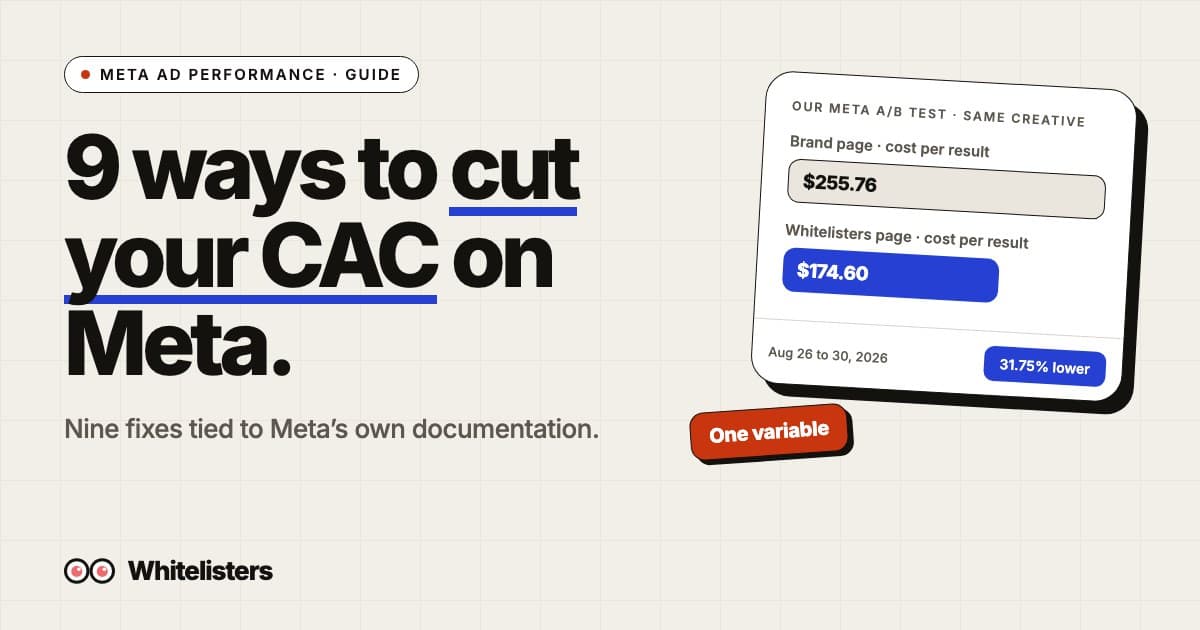
We ran this test in Meta Ads Manager’s Experiments tool in August 2026 (August 26 to 30). Both ad sets used the same creative, budget and audience. The only difference was the page identity: one ad set ran from the brand’s own page, the other from a Whitelisters creator page (@offthegridgirlie). The goal was website purchases, and each side spent about $4,350 (cost per purchase multiplied by purchases).
| Test group | Cost per purchase | Purchases | Reach | Impressions |
|---|---|---|---|---|
| A: Brand page | $255.76 | 17 | 291K | 506K |
| B: Whitelisters page | $174.60 | 25 | 259K | 521K |
Cost per purchase was 31.75% lower on the Whitelisters page. Treat this as one data point, not a promise. It is a single test with a small sample (17 and 25 purchases), and it ran for five days, shorter than the seven-day minimum Meta recommends for the most reliable A/B results. The way to know what your own ads will do is to run the same split on your account.
| Brand | Brand page | Whitelisters pages | Difference | Spend compared |
|---|---|---|---|---|
| Cloaked | $196.52 | $160.52 | 18% lower, $36 saved per purchase | $7.25M brand page vs $2.63M Whitelisters pages |
| Rise Science | $38.55 | $25.01 | 35% lower, and 26% lower cost per 1,000 impressions | $155K brand page vs $266K across 12 Whitelisters pages |
These compare ads that ran through each kind of page over real spend. They are not controlled experiments. For Cloaked, the comparison is Mindful-built ads on creator pages (230 ads) against the other ads on the brand page (3,301 ads), so the creative differs. For Rise Science it is the same Mindful-built ad concepts on 12 creator pages (619 ads) against the brand page (480 ads); the 24 concepts that ran on both cost $24.34 per purchase on creator pages and $38.02 on the brand page. Delivery cost also differed: Cloaked’s creator-page ads cost more per 1,000 impressions ($34.84 against $27.09) but converted better, while Rise Science’s creator-page ads were cheaper to show as well. The results point the same way as our A/B test, which is why we recommend testing it yourself.
The test is written up in full in partnership ads vs brand page ads and the two client accounts in the Cloaked and Rise Science case study. If you want to try it, start with our complete guide to Meta partnership ads.
3. Let ad sets finish the learning phase
Ad sets usually exit the learning phase after about 50 results in the week after the last significant edit. During learning, Meta says performance is less stable and ad sets usually have a higher CPA. Editing an ad, ad set or campaign during learning resets it. The practical rule: set a realistic budget, launch, and resist tweaking until the status moves out of “Learning.”
4. Consolidate instead of splitting
Meta’s learning-phase guidance says that creating many ads and ad sets means the delivery system learns less about each one, and that combining similar ad sets combines learnings. Its cost-per-result guidance repeats the advice to combine similar campaigns and ad sets so the delivery system can work more efficiently.
5. Broaden the audience
If your audience is too specific, it may cost more to reach your relevant audience. Meta’s pricing overview adds that ad sets with an audience of at least 2 million often see better performance. Use detailed targeting as a suggestion, not a wall.
6. Use Advantage+ placements
Meta says Advantage+ placements let its system place your ads across all available placements and that they are typically the most efficient use of your budget and help control costs. More placements gives the auction more chances to find the right person at the right price.
7. Let Advantage+ campaign budget move the money
Advantage+ campaign budget manages your budget across ad sets and distributes it in real time to the ad sets with the best opportunities. Also size the budget so each ad set can reach the roughly 50 results it needs: Meta warns that a very small or inflated budget gives the delivery system an inaccurate signal.
8. Refresh creative before it fatigues
Creative fatigue occurs when an audience has seen the same creative too many times, and it can lead to a higher cost per result. Meta shows a “Creative limited” status when cost per result is above past ads but under twice as high, and “Creative fatigue” when it is twice as high or more. Its fixes: add a new ad with materially different creative (keep the original running), expand the audience, or try Advantage+ creative. A steady supply of new creative is a low-cost way to protect your CAC.
9. Test one variable at a time, the right way
Everything above is a hypothesis until you test it. Meta’s guidance: change only one variable, use an audience that is not used elsewhere at the same time, and run for at least seven days, because tests shorter than seven days may be inconclusive. It also recommends the same budget on both sides and warns against informal testing by switching ad sets on and off, which can lead to overlapping audiences and unreliable results. Use the Experiments tool or Ads Manager’s A/B test, not a spreadsheet.
Where to start
- Fix structure first: consolidate ad sets, use Advantage+ placements and campaign budget, and size budgets for about 50 results a week per ad set.
- Then test creative against creative, one change at a time.
- Then test the page identity: same ad, brand page against a creator page.
- Keep a rolling queue of new creative so you never hit fatigue.
Frequently asked questions
What is a good CAC on Meta ads?
It depends on your margins, average order value and customer lifetime value, so there is no single good number. A useful target is a CAC low enough that you recover it within your payback window. Compare your CAC to your own past ads first, which is also how Meta’s cost-per-result recommendations work.
How long should I wait before changing an ad set?
Meta says ad sets usually exit the learning phase after about 50 results in the week after the last significant edit, and that editing during learning resets it. Wait until the delivery status leaves “Learning” before making meaningful changes.
Does raising my bid lower CAC?
Not necessarily. Meta’s auction picks the ad with the highest total value, which combines bid, estimated action rate and ad quality, so a more relevant ad can win against ads with higher bids.
Do creator pages always lower CAC?
No. In our A/B test the Whitelisters page cost 31.75% less per result, and in client data we saw lower cost per purchase too, but results depend on creative, audience and offer. Run the split on your own account.
What is the fastest way to lower CAC on Meta?
Start with structure: consolidate similar ad sets, use Advantage+ placements and campaign budget, and size budgets so each ad set can reach about 50 results a week. Meta recommends these steps in its cost-per-result guidance.
How do I know when my creative is fatigued?
Meta shows a Creative limited status when cost per result is above your past ads but under twice as high, and a Creative fatigue status when it is twice as high or more.

Zachary DiBlasi
Zachary DiBlasi is the founder and CEO of Whitelisters and MindfulAds.com. He has managed over $200m in ad spend for brands including Kalshi, MrBeast, Descript, Framer, Justin Bieber and Runna by Strava.