What Does Paid Partnership Mean? Instagram, Facebook and TikTok Explained
What the paid partnership label means on Instagram, Facebook and TikTok, how creators add it, how it differs from an ad, and what the FTC still requires.

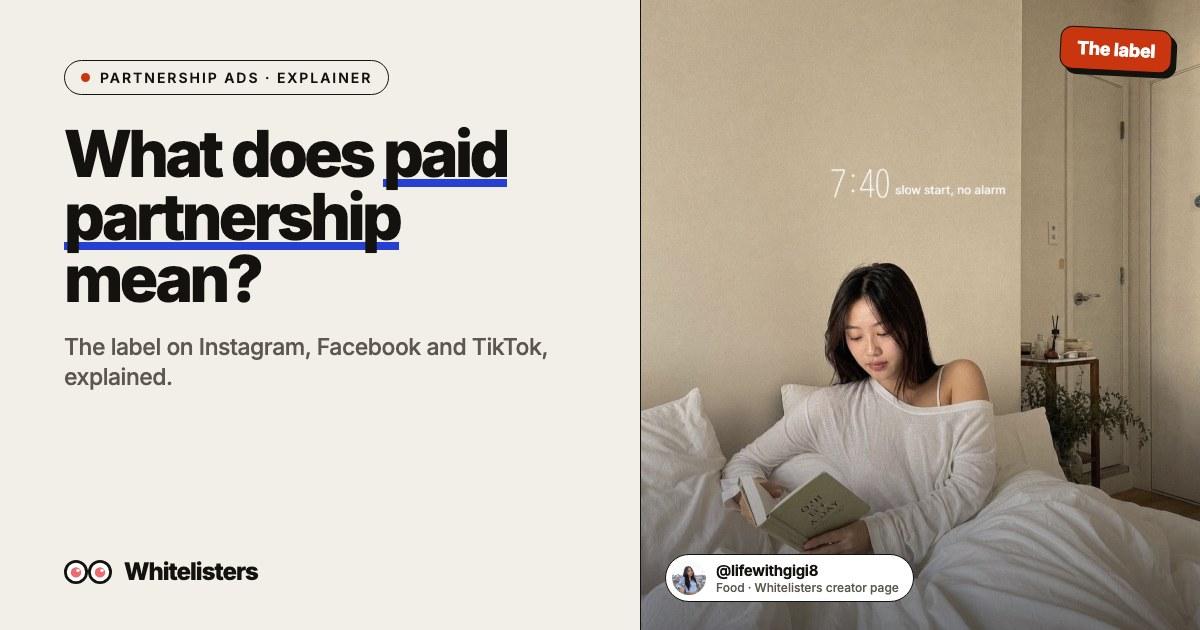
“Paid partnership” means the creator was paid, or otherwise compensated, by the brand named in the label. On Instagram, Facebook and Threads the label reads “Paid partnership with” followed by the brand’s name. On TikTok the label reads “Paid partnership” when a creator discloses branded content for a third party. The label is the platform’s disclosure tool; it does not by itself make the post an ad.
This explainer covers what the label means on each platform, how it gets there, how it differs from a sponsored post and from an ad, and what the FTC expects on top of it. Every platform detail is linked to the platform’s own help page.
What is a paid partnership?
A paid partnership is a commercial relationship between a creator and a brand in which the creator publishes content about the brand in exchange for payment, free product or another benefit. Platforms call this branded content. Meta’s definition is that paid partnership posts, or branded content, use the Paid partnership with label to disclose the name of a business or brand partner. The creator still owns the post and publishes it from their own account; the label tells viewers a brand was involved.
That is different from a partnership ad, where the brand pays Meta to run the content, or new creative, as an ad from the creator’s handle. The label appears in both cases, which is why people mix them up. The table further down separates the three.
What does paid partnership mean on Instagram?
On Instagram the label is required, not optional. Instagram’s branded content policies require creators to use the paid partnership label to tag the brand they are working with, and the label can be used in Feed, Stories, Broadcast Channels, Live, Reels and Instagram videos. Three details from the same help page explain the states you see in the wild:
- The brand has to approve the creator. The first time a creator tags a brand, a request goes to the brand. Once approved, the brand’s name appears in the label on that creator’s posts.
- A label with no brand name means the brand has not approved yet. Instagram shows the paid partnership label without the partner’s name until the request is approved.
- A denied request removes the label. If the brand denies the request, the label comes off the content.
The brand partner must have a professional account on Instagram, and the creator must have branded content enabled on their own account before the option appears. Once the content is published the brand is notified and can see the content’s insights; if the creator later removes the brand from the label, the brand is notified and loses access to those insights.
How do you add the paid partnership label on an Instagram post?
- Enable branded content on your Instagram account (a professional account is required).
- Create the post, story, reel or Live as normal.
- In the post’s settings, add the paid partnership label and search for the brand partner.
- Publish. If this is your first post with that brand, the brand receives a request and the label shows without the brand name until they approve it.
- Optionally, turn on Allow brand partner to boost so the brand can run the post as a partnership ad.
Instagram keeps the exact taps for each surface (post, story, reel, Live, broadcast channel) in its help page on the paid partnership label, and they change with app versions, so use that page for the current menu names. The boost toggle and the partnership ad code are explained in Instagram’s page on content-level permissions: with the toggle on and the brand tagged, the brand can create ads from that branded content; with a shared ad code, a brand can create ads from any post, story or reel, whether or not it is branded content.
What does paid partnership mean on Facebook?
The same label, the same meaning. Meta’s help page gives the format as “Paid partnership with” followed by the partner’s Instagram account, Threads account or Facebook Page name, so one label covers Instagram, Threads and Facebook. Two additional rules from that page matter for brands:
- Boosted content also gets an Ad label. If the paid partnership post is boosted or runs as an unpublished ad, an Ad label appears as well, just as it would on any other ad.
- Affiliate content needs the label without a tag. Content with an affiliate link should carry the paid partnership label but does not need a business partner tagged.
One Instagram-specific note that affects Facebook placements: a partnership ad run with a partner who has no Facebook Page can still appear on Facebook, showing the partner’s Instagram name, profile picture and other details.
What does paid partnership mean on TikTok?
On TikTok the label comes from the Commercial Content Disclosure setting, not from a tag on the post. In TikTok’s own steps, the creator opens Content disclosure and ads when posting, turns on Disclose commercial content, then chooses one of two options:
- Your brand: the creator is promoting their own business. TikTok adds a commercial content label to the post.
- Branded content: the creator is promoting a third party. TikTok says the label “will display Paid partnership if you are promoting a third party and posting branded content”. The creator can tap Brand partnership to tag the brand.
So “Paid partnership” on TikTok means the creator chose the Branded content option: someone other than the creator paid for the post. TikTok adds that the authorization period is 60 days by default, which is the window in which the tagged brand can use the post commercially unless the creator changes it. TikTok’s separate ad format for running a creator’s organic post as an ad is Spark Ads; how that compares with Meta’s partnership ads is in whitelisting vs partnership ads vs Spark Ads.
Paid partnership vs sponsored post vs ad: what is the difference?
“Sponsored” is the everyday word; “paid partnership” is the platform label; “ad” is paid distribution. One post can be all three. The table shows who publishes, who pays whom, and which labels appear.
| Organic paid partnership post | Partnership ad | Standard ad | |
|---|---|---|---|
| Who publishes | The creator, from their account | The brand, from the creator’s handle (Meta) or organic post (TikTok Spark Ads) | The brand, from its own page |
| Who pays whom | Brand pays creator | Brand pays creator for permission and pays the platform for delivery | Brand pays the platform |
| Labels shown | “Paid partnership with” and the brand’s name (Meta); “Paid partnership” (TikTok) | Paid partnership label plus an Ad label (Meta) | Ad or Sponsored label only |
| Who sees it | The creator’s followers and whoever the algorithm reaches | The audience the brand targets | The audience the brand targets |
The practical consequence for brands: the organic post reaches the creator’s audience once, while a partnership ad can run as long as the permission and budget last. For creators: the label is required on the organic post whether or not the brand ever boosts it.
Does the paid partnership label satisfy FTC disclosure rules?
Not on its own, in the FTC’s view. The FTC’s Endorsement Guides require that a material connection between an endorser and a brand be disclosed clearly and conspicuously. Its influencer guidance, Disclosures 101 for Social Media Influencers, tells creators not to assume a platform’s disclosure tool is good enough, and to consider using it in addition to their own clear disclosure. Meta points the same way: its policies say advertisers remain responsible for following applicable law, including disclosures that show the commercial nature of the content, and its Branded Content Policies add category rules on top (prohibited, restricted and pre-authorized categories).
A simple rule that satisfies both: use the platform label every time, and put a plain-language disclosure (“ad” or “paid partnership with Brand”) in the caption or on screen where it is hard to miss.
A worked example: planning around the permission window
The label is instant; the permission behind it has a clock. Suppose a creator publishes a TikTok on December 1 with Branded content selected and your brand tagged. TikTok’s default authorization period is 60 days, so the window closes on January 30. A 30-day campaign that starts on December 8 ends on January 7, inside the window with 23 days to spare. A 90-day campaign would run past January 30, so you would need the creator to extend the authorization before day 60 or the post stops being available to you. On Meta, account-level partnership ad permission has no fixed expiry; it lasts until either side revokes it, which is why most ongoing programs ask for account-level rather than per-post permission. Those numbers are arithmetic on the platforms’ stated defaults, not performance claims.
Where Whitelisters fits
Every ad a brand runs from a Whitelisters creator page is a Meta partnership ad, so it carries the “Paid partnership with” label naming your brand, and the Ad label, automatically. The permission is account-level and is requested for you when you pick a page; how that request looks in Meta and how the ad is built in Ads Manager are documented with screenshots. What whitelisting is as a practice is in what is whitelisting on social media.
Frequently asked questions
What does paid partnership mean on Instagram?
The creator was compensated by the brand named in the label. Instagram’s branded content policies require the label on branded content, and the brand’s name appears once the brand has approved the creator’s tag request.
What does paid partnership mean on TikTok?
The creator turned on Disclose commercial content and chose Branded content, which TikTok uses when a third party paid for the post. Choosing Your brand instead adds a commercial content label for the creator’s own business.
Is a paid partnership post the same as an ad?
No. An organic paid partnership post is published by the creator to their own audience. It becomes an ad only when the brand or creator pays the platform to promote it, at which point Meta adds an Ad label alongside the paid partnership label.
Why does a post say Paid partnership without a brand name?
On Instagram the brand has not yet approved the creator’s tag request. The label shows without the partner’s name until approval, and it is removed if the brand denies the request.
Do I still need #ad if I use the paid partnership label?
The FTC’s influencer guidance says not to assume a platform’s disclosure tool is sufficient and to consider using it in addition to your own clear disclosure. Use the label and add a plain-language disclosure.
How long does a TikTok paid partnership authorization last?
TikTok says the authorization period is 60 days by default. The creator can change it, and a brand that needs a longer window should ask before the period ends.
What is the difference between branded content and a partnership ad?
Branded content is the creator’s organic post with the paid partnership label. A partnership ad is that content, or new creative, run as an ad from the creator’s handle by the brand through Ads Manager. Meta used to call partnership ads branded content ads.

Zachary DiBlasi
Zachary DiBlasi is the founder and CEO of Whitelisters and MindfulAds.com. He has managed over $200m in ad spend for brands including Kalshi, MrBeast, Descript, Framer, Justin Bieber and Runna by Strava.
Sources
- Meta: About labels on paid partnership posts
- Instagram: How to use the paid partnership label to tag organic branded content
- Instagram: Manage content-level permissions for partnership ads
- Meta: Branded Content Policies
- TikTok: How to turn on the Commercial Content Disclosure setting
- FTC: Guides Concerning the Use of Endorsements and Testimonials (16 CFR Part 255)
- FTC: Disclosures 101 for Social Media Influencers